The sky: aeroplane facts with their sources
Sourced answers about flight, aircraft, airport terminology and aviation history, free to read.
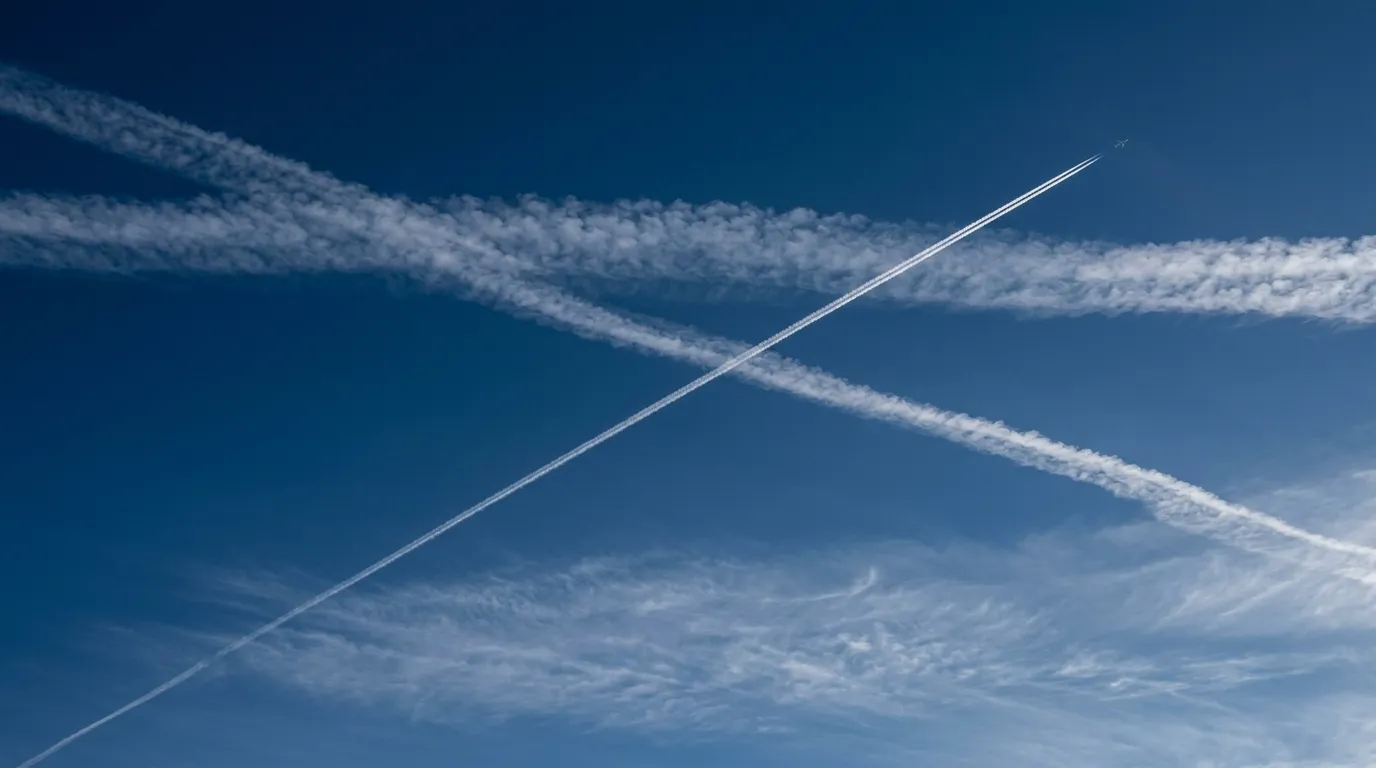
Something goes over and you look it up. That's where this site starts. These pages answer questions about flight, airports and aircraft history, naming the sources behind their explanations: the Civil Aviation Authority, the FAA, NASA, NOAA, NIST, the statute book and museums. Where the usual explanation turns out to be something everyone repeats and no primary source publishes, the page says so and does not pass it on. The explanations are free to read.
Aeroplane facts, each with its source
Eleven short answers from the pages below. Each names the body that published the figure, and the link takes you to the full page and its source.
- Cruising height: passenger jets cruise at about 10 to 13 km, roughly 33,000 to 43,000 feet, according to Airbus.
- Cruising speed: larger airliners cruise at roughly 600 mph, about 80 per cent of the speed of sound, according to NASA.
- The knot: one nautical mile per hour, and the international nautical mile is exactly 1,852 metres (NIST).
- Contrails: water vapour from the exhaust condenses and freezes into ice crystals, NOAA explains.
- Clear-air turbulence: the FAA says it normally occurs above 15,000 feet, in or near the jet stream.
- Runway numbers: on a numbered runway, the number gives a direction, not a name.
- Squawk 7700: an emergency, with no cause named in the UK rule, SERA.13005.
- Lift: wings turn the air flowing past them, and NASA says the pressure and the Newton explanations are both correct.
- Widest wingspan: the Stratolaunch Roc, at 117.35 metres, according to Guinness World Records.
- Concorde: first flew on 2 March 1969, and British Airways ended its flights in October 2003.
- White paint: no regulator or manufacturer we could find publishes why airliners are painted white.
The reading, in order
- How do planes fly?
- How high do planes fly?
- How fast do planes fly?
- What is a knot in aviation?
- What is turbulence?
- What are the main types of aircraft?
- What is a cockpit?
- Why are planes white?
- Why do planes leave white trails?
- What is a runway?
- What is an airport code?
- What is plane spotting?
- What is an aerodrome reference code?
- The Spitfire story
- How to identify an aircraft
- What is a squawk code?
- The Lockheed Constellation
- The Concorde story
- What is the largest aeroplane in the world?
- What do the parts of an aircraft do?
What these pages keep concluding
The same care applies across these pages: a flight figure needs its conditions, an airport term needs its definition, and an aircraft's story needs its sources. Read whichever question brought you here, or follow the related links to put it in context.
And after that
The stage that follows this one is your aircraft: One photograph of one particular aircraft, and everything that can be done with it.