The Lockheed Constellation: history, variants and where to see one
The Lockheed Constellation was a pressurised airliner that Lockheed began designing in the late 1930s to meet TWA's call for non-stop coast-to-coast flights. It first flew on 9 January 1943, as a military transport, and the stretched Super Constellation that followed was built in numbers: 579, by the National Air and Space Museum's count.
The Lockheed Constellation: what it was built to do
The National Air and Space Museum (NASM) says Lockheed began design work in June 1938 on an airliner for Transcontinental and Western Air, later TWA. NASM gives the requirement as a non-stop transcontinental airliner with a 3,500-mile range and a 6,000 lb payload. Lockheed Martin's own history dates the key meeting to 1939, with Howard Hughes, who had by then bought a majority stake in TWA. The two accounts differ on the year, 1938 against 1939.
Did Hughes design it? Lockheed Martin's account says not quite: Hughes outlined the initial performance specifications, and Lockheed's team, which it names as president Robert Gross, chief engineer Hall Hibbard and chief research engineer Kelly Johnson, designed the aircraft.
First flight, the war and a record
NASM says construction of a prototype began in 1940. With the United States at war, transport production went to military needs, so the prototype first flew on 9 January 1943 as a military aircraft, and in wartime it was better known by its military designation, the C-69. Lockheed Martin says the aircraft was to offer the first hydraulically boosted power controls and a pressurised cabin, and that only 13 Constellations were built during the war. In April 1944 Hughes set a transcontinental speed record on a flight from Burbank to Washington, DC: 331 mph, nonstop, in 6 hours 57 minutes 51 seconds. Aviation more often quotes speed in knots, which what is a knot in aviation explains. Lockheed Martin says TWA bought back all the C-69s it could from the government after the war, and that the Constellation entered commercial service in February 1946.
Constellation or Super Constellation?
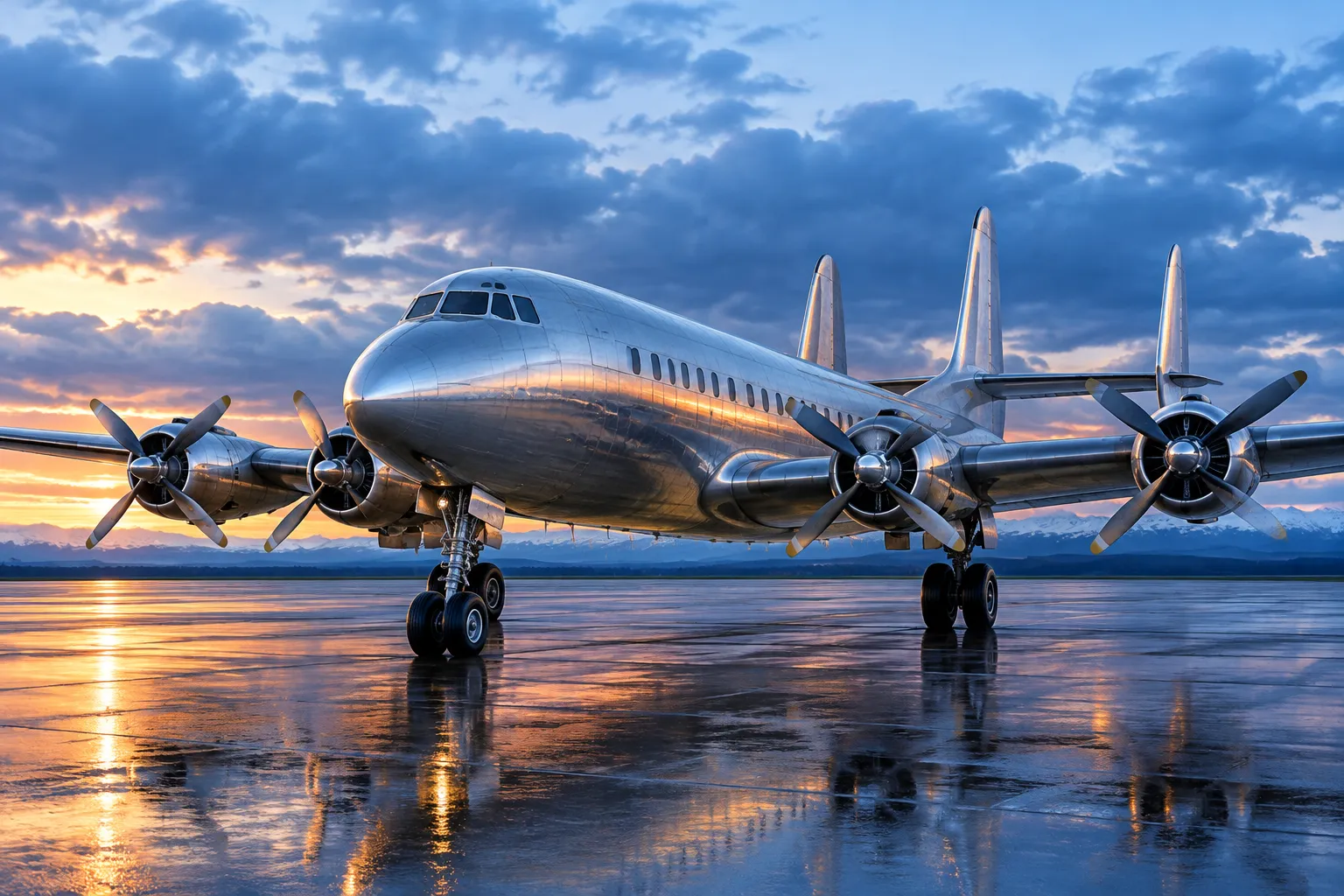
NASM sorts the family by model number. The L-649 was the first built as a commercial type, and the L-749 its long-range version. The L-1049 Super Constellation came next: a stretched fuselage, 95 ft 2 in lengthened to 113 ft 7 in, with more fuel, more powerful engines, a higher gross weight and tourist-class seating raised from 69 to 92. The production version also swapped the Constellation's round windows for rectangular ones. It entered service with Eastern Air Lines in December 1951. NASM counts 579 Super Constellations built.
NASM groups the Super Constellation with the Douglas DC-7 as the final development of piston-engined airliners. Turbine-powered aircraft arrived soon after: NASM says the Bristol Britannia and the Boeing 707-120 made propeller-driven aircraft obsolescent in October 1958. Lockheed Martin says the last commercial Constellation was built in 1959, and NASM says only four Super Constellations were still in airline service at the end of 1980. For another design from the same war, see the Spitfire story.
Did BOAC fly the Constellation to New York?
Yes. British Airways' media centre, in a release dated 1 July 2026 marking 80 years of flying to the US, says BOAC began the first commercial landplane service from London to New York LaGuardia on 1 July 1946. It used an L-049 via Shannon and Gander, and the journey took nearly 20 hours.
Air Force One and the military Constellations
According to Lockheed Martin, President Eisenhower's personal plane, a VC-121E, was the first to carry the name Air Force One when the president was aboard. It adds that the US military bought nearly 40 per cent of all the Constellations ever made. NASM's own C-121C, one of 33 delivered to the USAF, served with the 1608th Air Transport Wing, whose Super Constellations took part in the Hungarian airlift of 1956-57, and retired from military service in November 1977.
Can you see a Constellation in the UK?
The Science Museum Group holds an L-749, serial 2553, built in September 1947: object number 1984-249 in its collection. It's stored at Wroughton, Wiltshire, and the collection entry says it can be seen only on open days, so it isn't a regular display. Sources differ on which airline took it first: the Science Museum Group names TWA, while enthusiast sources say KLM. The sky hub has more aircraft history to read.
Photographed one at a museum or an airshow? Polished aluminium and a curved fuselage suit the vintage poster style described in aircraft art styles explained, and types of aircraft shows where an airliner like this sits in the legal categories.