Airport code lookup
Type a code - LHR, EGKK, or whatever is on the mug - and get the airport it belongs to, the other code it carries, and the coordinates. UK and Irish airports with an IATA code are here, every other UK airfield with an ICAO code, plus the major airports worldwide.

Airport data from OurAirports (public domain), read 2026-09-26. This list carries the 112 UK and Ireland airfields with an IATA code (whatever their size), the 56 other UK airfields with an ICAO code, and 1,128 large scheduled-service airports worldwide.
Where a code matches nothing here, the tool says so and does not guess. Some small airfields share a municipality name - pick from the list when that happens.
How to search for an airport code
Either code works. Type the three letters from a boarding pass or the four from a chart, and the same airport comes back with both codes on it - so you can arrive knowing one and leave with the other. A place name works too, which is the way in when you know where somebody flew from but not what it's called in code.
Results cover every UK and Ireland airport with an IATA code, every other UK airfield with an ICAO code, and the large scheduled-service airports worldwide. Smaller foreign airfields, and UK airstrips with no code, are not in the set: where a code matches nothing, the tool says so and offers no nearest guess.
Heathrow has its own page: the Heathrow airport code. Four more have theirs: Gatwick, LGW, Manchester, MAN, Edinburgh, EDI and Birmingham, BHX.
Airport codes for Malaga, Palma, Amsterdam and Belfast City
Four examples from the lookup's own data, read from the same OurAirports list as every other result. Type either code, or the place name, and the tool returns the airport with both codes and its coordinates.
| Airport | IATA | ICAO |
|---|---|---|
| Málaga-Costa del Sol Airport | AGP | LEMG |
| Palma de Mallorca Airport | PMI | LEPA |
| Amsterdam Airport Schiphol | AMS | EHAM |
| George Best Belfast City Airport | BHD | EGAC |
What the coordinates line is for
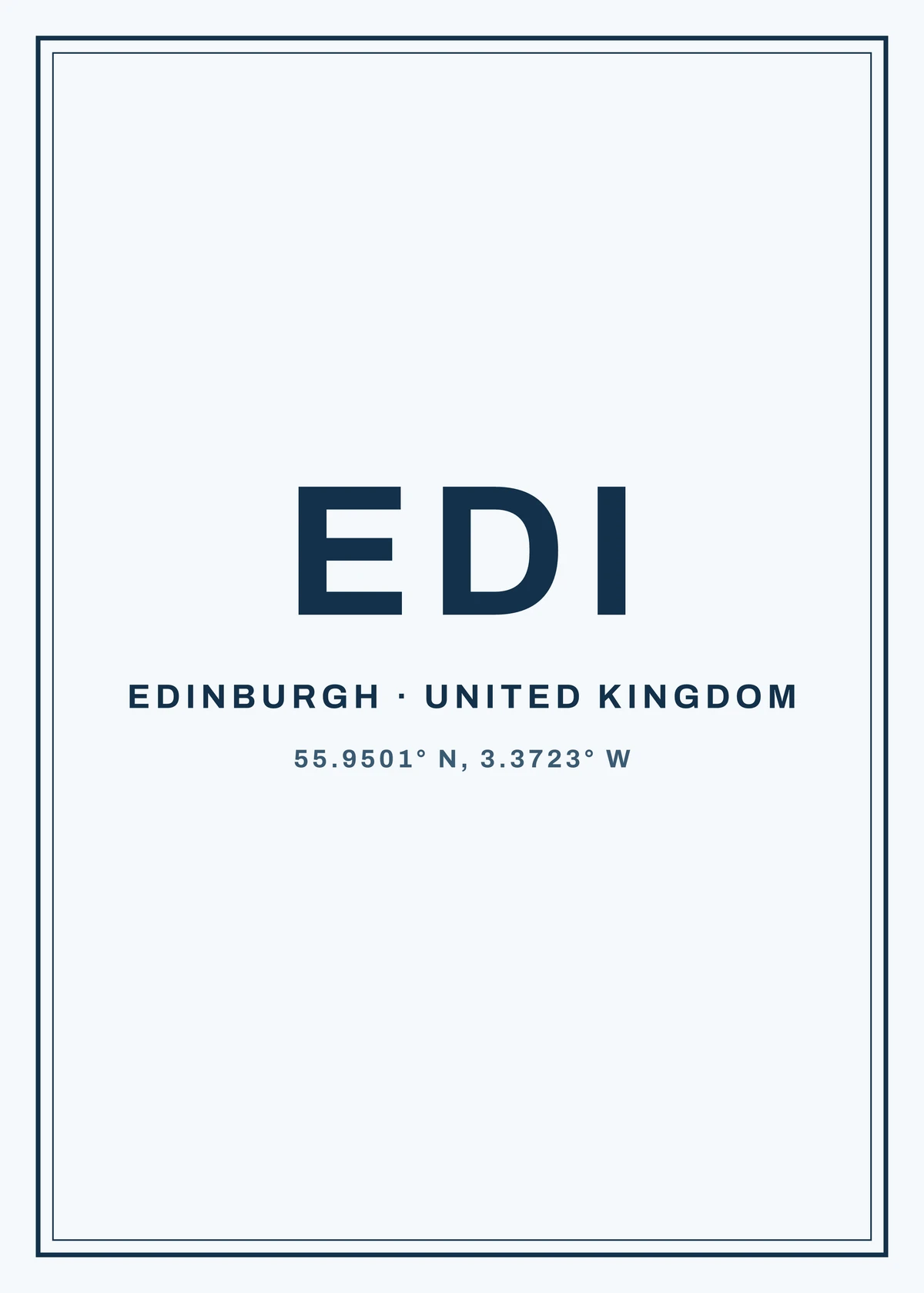
Each result carries the airport's position to four decimal places, which is the same line the airport-code print sets beneath the code: the code huge in navy, the airport name, and the coordinates beneath it. The airport code print fills that layout from whatever you type, and each result here links straight to it with the code filled in, so you never have to look the pieces up one at a time.
Once you have the code, set it in type on the airport code print and see the print before you order.

For what the codes mean and why one of them ends up on a wall, what is an airport code carries the sourced answer; the airport code print is the thing it prints onto.
The rows come from OurAirports' open data, which its publishers release into the public domain, read 2026-09-26. The UK and Ireland list is complete down to the smallest airfield that carries an IATA code, and it adds every other UK airfield OurAirports lists with an ICAO code; worldwide, the tool carries the large scheduled-service airports, because that is where a code on a boarding pass comes from.
A free lookup for the code that goes on the print: type a code or a place name, get the airport, its name and its position back.