Plane spotting photography: getting a print-worthy shot
Most of your spotting photos are for you: the logbook in pictures. But every so often you get one that stops you, and that's the one that belongs on a wall. The gap between a snapshot and a frameable shot isn't expensive gear. It's a handful of settings, knowing where to stand, and a little patience. Here's how to come home with shots worth printing, then turn the best into wall art.
What camera and lens do you need?
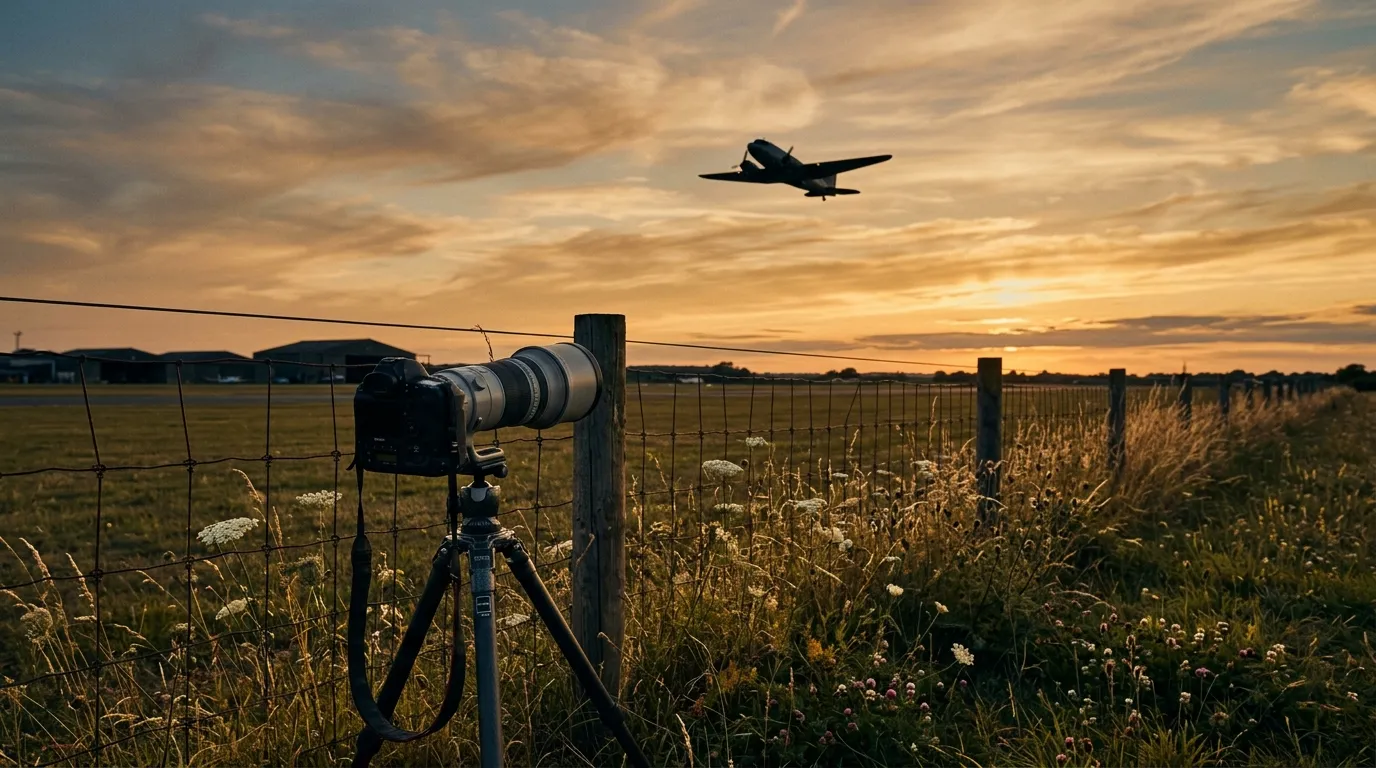
Reach matters more than anything here. Aircraft are far away and they don't wait, so you want a long lens: 300mm is a sensible floor, and 400mm or more earns its keep at the bigger airports where the action sits across the field. A bridge camera with a long zoom will get you started; a mirrorless or DSLR body with a telephoto will get you further. The one feature you can't really do without is continuous autofocus that tracks a moving subject. Everything below assumes you've got that.
Don't agonise over the body. Light, sky and timing decide far more of your keepers than the badge on the front. A modest setup used well beats an expensive one pointed badly.
A couple of extras earn their place once you're out for a few hours. A monopod takes the strain of a heavy lens off your arms and steadies the long focal lengths where camera shake bites hardest, far less fiddly than a tripod when you're swinging to follow an aircraft. A lens hood cuts flare when the sun's low and side-on, which is exactly when you'll be shooting your best light. And spare batteries: cold weather and burst mode drain a battery faster than you'd think, and the keeper always seems to come along just as the last bar dies.
What settings should you use?
This is where most spotting shots are won or lost. Get these four right and you're most of the way there.
- Shutter speed: 1/1000s or faster freezes jets cleanly. For propeller aircraft, you go the other way: drop to around 1/250s or slower so the prop blurs into a disc. A frozen propeller looks dead, like the engine's been switched off mid-air, and it's the single most common giveaway of a beginner's prop shot.
- Autofocus: continuous (Canon calls it AI Servo, Nikon AF-C), with subject tracking on. Put your active point on the cockpit or the nose, that's the bit you most want sharp.
- Drive: burst mode, every time. You'll bin most of the sequence; one frame will sing. Wings flex, light shifts, the angle changes frame to frame, and the keeper is rarely the one you'd have picked if you'd fired a single shot.
- Aperture: f/5.6 to f/8 keeps the whole airframe sharp without softening the edges. Wide open, depth of field gets thin and a nose-on aircraft can have a sharp cockpit and a soft tail.
ISO is the one you let move. Set shutter and aperture for the shot you want, then raise ISO as much as you need to hold that shutter speed. A slightly grainy sharp photo beats a clean blurry one every single time, and modern sensors handle high ISO far better than most spotters fear. The order of priority is sharpness first, noise second.
How do you shoot jets versus props?
These are two different jobs, and it trips people up. For a fast jet, the whole point is to freeze it: a hard, crisp airframe against the sky, every panel line sharp. Crank the shutter up. The UK airshow photography community generally treats 1/500s as a working minimum for jets on a long lens, and many push to 1/1000s or beyond to be safe, per the Military Airshows photography guide.
Props are the opposite. If you freeze a propeller you've made a model aeroplane, not a flying one. You want that prop smeared into a translucent arc, which means slowing the shutter right down: Nikon's airshow guide cites figures as low as 1/125s, and dropping further toward 1/60s gives you a fuller disc, per Nikon's own tips on airshow photography. The catch is that a slow shutter punishes any wobble, so this is where panning comes in.
Panning is just tracking the aircraft with your whole upper body as it passes: twist from the trunk, follow it smoothly through the viewfinder, and keep moving even as the shutter fires. Done well, the aircraft stays sharp while the background streaks, which sells the speed and lets you use those slower prop-blur shutter speeds without ending up with a soft airframe. It takes practice. Your first dozen pans will be bin-fodder. Stick with it: when it clicks, prop shots suddenly look like everyone else's good ones.
Where should you stand, and what about the light?
Keep the sun behind you. Light on the aircraft means a lit aircraft; sun in front of you means a silhouette, which is dramatic occasionally but useless most of the time. So before you set up, work out where the sun will be for the hours you're there.
Then learn the runway in use and the approach line. Aircraft land and take off into the wind, so the active runway shifts with the weather, and being on the wrong side means shooting tail-ends all afternoon. Most major airports have well-known viewing spots chosen precisely because the geometry of light and approach works, ask around or check a spotting forum for the field you're visiting.
Light has a clock, too. The hour after sunrise and the hour before sunset give you low, warm, side-on light that wraps around an airframe and makes metal glow. Harsh midday sun flattens everything and blows out white fuselages. If you can pick your time, pick the edges of the day. It's the difference between a record shot and one you'd hang up.
How do you compose for a print?
Shoot with the wall in mind, not just the logbook. A few habits make a frame print-ready:
- Angle: side-on and three-quarter views frame best. Three-quarter, where you see the nose and one side, gives you shape and depth without the flatness of a pure profile.
- Room to breathe: leave a little space around the aircraft. You can crop in later; you can't add back what you didn't capture. A plane jammed against the frame edge looks cramped on a wall.
- Orientation: landscape suits most aircraft and most prints. Portrait works for a steep climbing departure, where the vertical lines do the storytelling.
- Resolution: shoot at your camera's full resolution. A clean patch of sky behind the subject helps too, though clutter matters less if you plan to restyle the shot.
How should you edit your shots?
A little goes a long way, and over-editing reads worse than no editing at all. Crop and straighten first. A tilted horizon pulls the eye harder than almost anything else in an aviation shot, and it takes seconds to fix. Then lift the shadows a touch if the underside of the aircraft has gone dark, pull the highlights back if the sky's blown, and add a modest amount of sharpening. That's usually it.
Resist the urge to crank saturation until the sky turns radioactive. The shots that hold up on a wall look like the day looked, only a bit better. If you shot in RAW you've got far more room to recover detail; if you shot JPEG, go gentle, because the file has less to give. Then pick your one frame from the burst (the sharpest, best-lit, best-angled) and let the rest go.
Zoom right in at 100% before you commit to a frame for printing. A shot that looks razor-sharp on the back of the camera can soften up at full size, and motion blur on the airframe (as opposed to the propeller, which you want blurred) only shows when you go in close. If two frames are close, the one with the sharper eye-line on the cockpit usually wins. That's the detail a viewer's eye lands on first, and it's the one a large print will expose.
Is your photo big enough to print?
This is the question that decides whether a good shot becomes a good print. Our actual numbers are below.
We grade every upload before you can buy it. The check runs against the print file, which is slightly larger than the finished piece because it carries bleed, and it takes the more demanding of the two dimensions after the image is cropped to shape. Anything that would land under 140 dpi is removed from sale rather than sold to you with a warning attached, so a size you can select is a size we are willing to stand behind.
| Format | Size | Smallest we will sell (140 dpi) | Megapixels | Ideal (300 dpi) |
|---|---|---|---|---|
| Poster | A4 | 1202 × 1682 | 2.0 | 2575 × 3603 |
| Poster | A3 | 1682 × 2360 | 4.0 | 3603 × 5056 |
| Poster | A2 | 2360 × 3319 | 7.8 | 5056 × 7111 |
| Poster | 50x70 cm | 2800 × 3903 | 10.9 | 6000 × 8363 |
| Poster | 70x100 cm | 3903 × 5556 | 21.7 | 8363 × 11906 |
| Framed poster | A3 | 1682 × 2360 | 4.0 | 3603 × 5056 |
| Framed poster | A2 | 2360 × 3319 | 7.8 | 5056 × 7111 |
| Canvas | 30x40 cm | 2040 × 2591 | 5.3 | 4371 × 5552 |
| Canvas | 40x50 cm | 2591 × 3142 | 8.1 | 5552 × 6733 |
| Canvas | 50x70 cm | 3142 × 4245 | 13.3 | 6733 × 9095 |
| Canvas | 60x80 cm | 3693 × 4796 | 17.7 | 7914 × 10276 |
| Framed canvas | 30x40 cm | 2040 × 2591 | 5.3 | 4371 × 5552 |
| Framed canvas | 40x50 cm | 2591 × 3142 | 8.1 | 5552 × 6733 |
| Framed canvas | 50x70 cm | 3142 × 4245 | 13.3 | 6733 × 9095 |
| Metal | 30x40 cm | 1714 × 2274 | 3.9 | 3671 × 4871 |
| Metal | 40x50 cm | 2274 × 2834 | 6.4 | 4871 × 6071 |
| Metal | 50x70 cm | 2834 × 3954 | 11.2 | 6071 × 8471 |
| Wood | 30x40 cm | 1714 × 2274 | 3.9 | 3671 × 4871 |
| Wood | 40x50 cm | 2274 × 2834 | 6.4 | 4871 × 6071 |
Two things worth knowing about that table. The middle column is the floor, not the target: 300 dpi is where a print stops being limited by the file at all, which is the last column. And the figures assume your photo is already roughly the shape of the print. A 3:2 frame going onto a square-ish canvas loses the sides to the crop, so it needs more pixels than the table says, not fewer.
In practice a modern camera clears the wall-art sizes comfortably and a recent phone clears most of them. The shots that fail are usually heavy crops: a distant aircraft cropped to a quarter of the frame is a quarter of the pixels, whatever the camera was.
Which shots make the best prints?
Not every good photo is a good print, and it's worth being honest about which is which. The ones that work on a wall share a few things: a clean, uncluttered background; light that flatters the airframe; a strong, recognisable angle; and enough resolution to hold detail at size. A sharp three-quarter shot of an aircraft you have a connection to: the type you flew, the airline you grew up watching, the heritage warbird from last summer's show: almost always beats a technically perfect frame of something you feel nothing about. Personal trumps perfect.
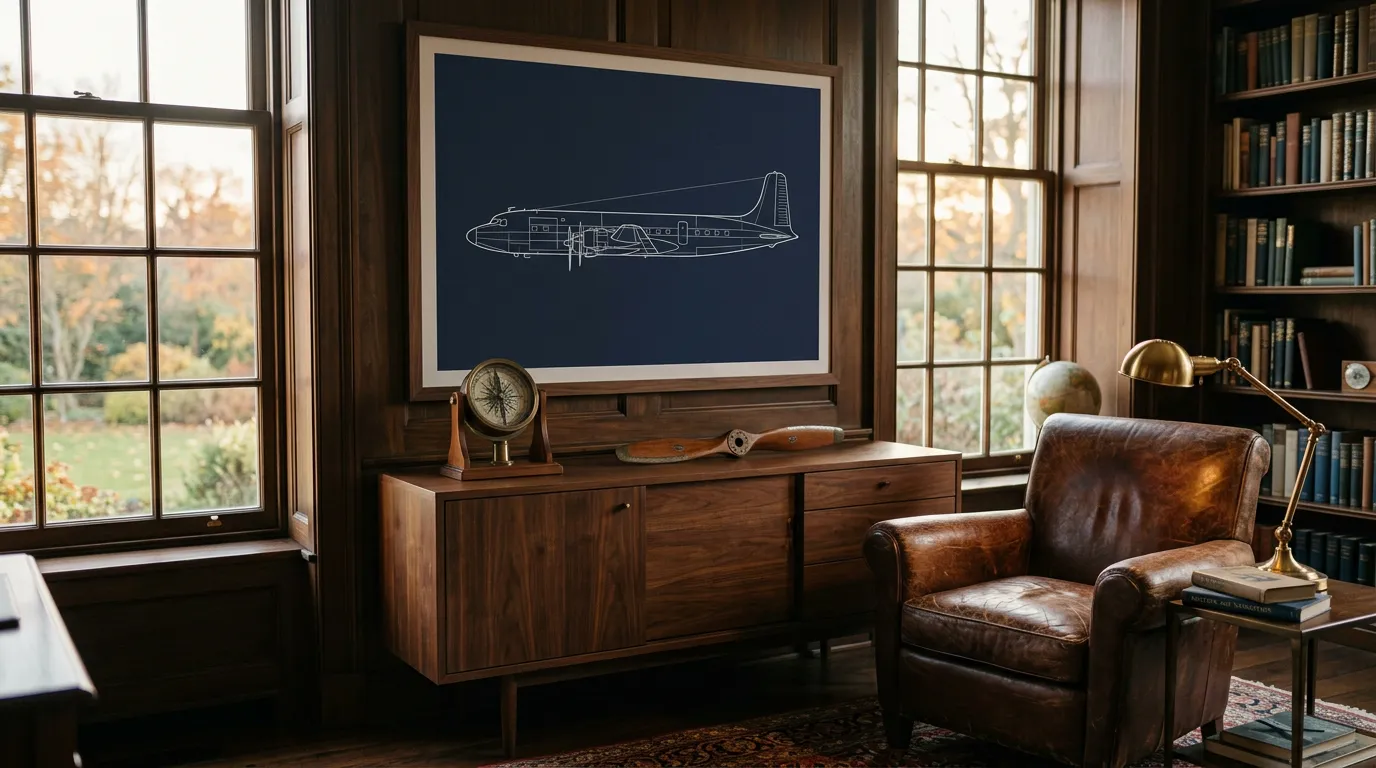
And if a shot is sharp but the background's busy, that's exactly the candidate for a restyle. A blueprint or vintage-poster treatment leans into the subject and quietly forgives a messy sky.
From card to wall
Once you have got the shot, your aircraft is the stage that does something with it. Keep it as a clean photo with the photo print, or have the aircraft print restyle it into a blueprint, vintage poster or watercolour. The same file works on a canvas or metal print. There's a full walkthrough in turning plane photos into wall art, and if you're shopping for a fellow spotter, the gifts for plane spotters collection is a good place to start.
Spotting responsibly
One last thing, because it matters. Stick to public areas and recognised viewing spots, follow airport signage, and don't photograph where it's restricted. The UK has a strong, welcomed spotting culture precisely because most spotters keep it courteous: turn up, behave, and you keep the door open for everyone who comes after you.
More guides: turn plane photos into wall art · aviation gift ideas · plane spotter gifts
Written by Craig Fearn, The Aviation Gift Co. Last updated .